
1
Shallow posts
Photo: post pulled from ground
Posts not set deep enough lever right out of saturated soil under wind load.
PreventionSet posts to the depth the code or engineering calls for — deeper for taller, solid fences.
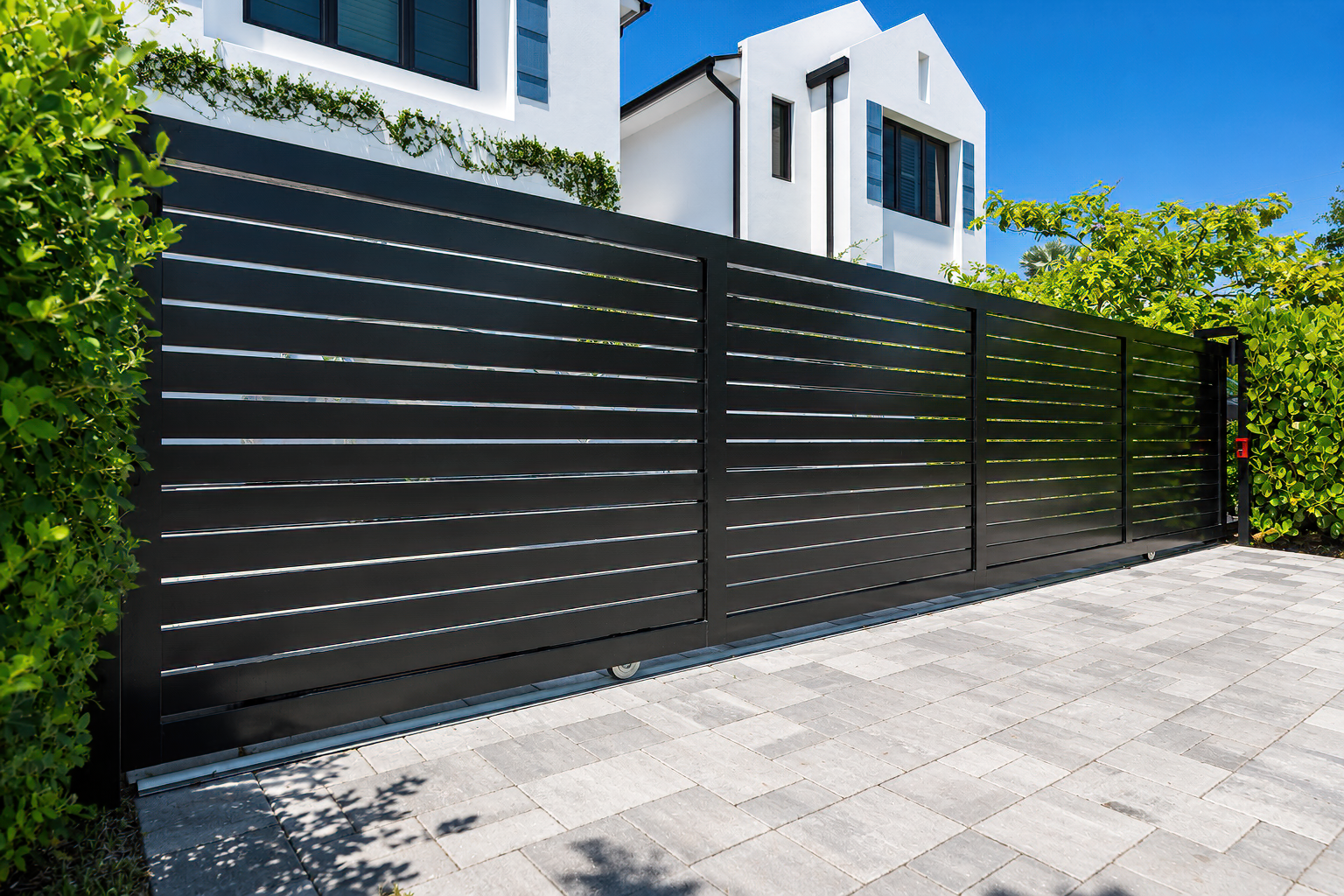
But some survive storms dramatically better than others.
A homeowner's guide to wind ratings, fence materials, and storm survival. Learn how wind actually affects fences, what the Florida Building Code requires, and which systems offer the best real-world hurricane resistance.
Open fences let wind pass through and sway less. Solid privacy panels catch the wind like a sail — watch them flex harder as the speed climbs.
Section 01 — The Bottom Line
Quick Answer
The single biggest factor is whether wind passes through the fence or pushes against it. Open fences shed wind; solid privacy fences catch it. Here's how the common materials rank for storm survival.
Every fence depends heavily on installation quality. A properly installed solid fence can outlast a poorly installed open one. Material sets the ceiling; the install decides whether you reach it.
Section 02 — Physics
How Wind Actually Destroys Fences
Fences rarely fail because wind speed "exceeded a rating." They fail because pressure builds against a solid surface faster than the posts and footings can resist it — then debris, saturated soil, and falling branches finish the job.
Solid privacy fence High wind load
Wind hits the solid panel, pressure builds, the post bends, and panels begin to separate at the rails. The whole panel behaves like a sail trying to tear free of its frame.
Open aluminum fence Wind passes through
Air flows between the pickets, so far less pressure is transferred to the posts. The same gust that flexes a solid fence barely loads an open one.
Force against a solid surface overwhelms the posts and footings.
Airborne objects punch through or knock down panels.
Waterlogged ground loses grip on the footings.
Falling limbs and uprooted trees crush whole runs.
Section 03 — Compare
Hurricane Survival Scorecard
Sort the cards by what matters most to you. Each material is scored 1–5 across the categories that decide how a fence holds up — and how you live with it — in South Florida. Tap a category to re-rank.
Scores are general guidance for South Florida conditions; real performance depends on the specific product, height, exposure, and installation. "Value" reflects relative affordability.
Section 04 — The Scale
Hurricane Wind Ratings Explained
Hurricane categories describe sustained wind speed on the Saffir–Simpson scale. Wind pressure rises with the square of speed, so the jump from a Cat 1 to a Cat 4 is far more than "twice as bad."
Well-built fences usually survive; loose panels and old wood at risk.
Solid privacy fences take real load; weak footings start to fail.
Major-storm pressure; panel blowouts and post failures common.
Most solid fences fail; open, well-anchored fences fare best.
Catastrophic; survival depends on anchoring, debris, and luck.
South Florida fences are built to the Florida Building Code's High-Velocity Hurricane Zone provisions — engineered for design gusts well above everyday wind.
Section 05 — #1 Performer
Why Aluminum Usually Performs Best
Aluminum's advantage isn't brute strength — it's that the open picket design simply gives the wind less to push against, while resisting the salt-air corrosion that destroys other materials in South Florida.
Gaps between pickets let wind flow through, dramatically reducing the pressure transferred to posts.
Strong, light extrusions resist bending without adding the mass that makes solid panels act like sails.
Powder-coated aluminum shrugs off salt air — critical on coastal and canal lots.
Damaged sections and pickets can be swapped without rebuilding the whole run.
Mechanical (bracketed) is cost-effective and strong; welded adds rigidity for gates and exposed runs; HR10 pool-code meets barrier spacing; double top rail stiffens tall or windward runs.
Section 06 — Privacy Leader
Vinyl Fence Performance in Hurricanes
Vinyl (PVC) is the privacy favorite, and modern reinforced systems survive storms far better than the brittle panels of a decade ago. The catch is that a solid panel is, by definition, a sail.
Full privacy, no rot or corrosion, low maintenance, and a clean look that lasts.
Panel blowouts, rail separation, and post failure — almost always traced to undersized footings or wide post spacing.
Steel-reinforced posts and rails, tighter post spacing, and heavy-wall (catalyst-grade) PVC profiles.
On-trend but loads rails differently — it needs careful engineering and spacing in wind zones.
Section 07 — Highest Risk
Wood Fence Performance in Hurricanes
Wood can look great and, when built right, hold up to a moderate storm. But it is the most storm-vulnerable common material in South Florida — and the way it's built decides everything.
Deep posts, properly sized concrete footings, quality hardware, and a wind-friendlier panel layout.
Shallow posts, rot at the base, weak nails, and solid stockade panels that catch maximum wind.
Shadowbox (alternating boards) lets some air through and loads posts less than a fully solid stockade.
Open or spaced-picket wood designs shed far more wind than a sealed privacy panel.
Section 08 — Coastal & Canal
Waterfront Properties Require Different Thinking
Canal-front, Intracoastal, and lakefront homes face conditions an inland lot never sees. The "best" fence on the water is the one that resists corrosion, lets surge and debris pass, and respects drainage.
Powder-coated or marine-grade aluminum is the default waterfront pick — corrosion-resistant, wind-shedding, and debris-friendly. Where privacy is essential, use a reinforced PVC system and confirm drainage.
Check for canal-maintenance and drainage easements and required setbacks. A fence that blocks access or water flow can be ordered removed — see our fence permit guide.
Section 09 — The Real Secret
Installation Matters More Than Material
This is where most storm survival is actually won or lost. A properly installed vinyl fence routinely outperforms a poorly installed aluminum one. The footing is the fence.
Section 10 — Failure Modes
7 Reasons Fences Fail During Hurricanes
Almost every storm failure traces back to one of these seven causes. Tap each card for how to prevent it.
Posts not set deep enough lever right out of saturated soil under wind load.
PreventionSet posts to the depth the code or engineering calls for — deeper for taller, solid fences.
Too little concrete, or footings that never fully cured, can't hold the post in a storm.
PreventionUse correctly sized footings poured to full depth and allowed to cure before panels go up.
Rotted wood and corroded steel lose strength long before the storm arrives.
PreventionChoose corrosion-resistant materials near salt air; inspect and replace compromised posts.
Falling limbs and uprooted trees crush even well-built fences.
PreventionTrim overhanging branches and remove dead trees well before storm season.
Standing water softens the soil that's supposed to anchor your posts.
PreventionGrade and drain the fence line so water moves away from the footings.
Loose or missing brackets, screws, and gate hardware let panels separate.
PreventionTighten and replace hardware annually; use corrosion-rated fasteners.
An old, neglected fence has lost capacity in every component.
PreventionInspect each season and budget to repair or replace aging runs before they fail.
Section 11 — Before the Storm
Hurricane Preparation Checklist
Run through this before each season — and again when a storm is named. Check items off as you go, then print the list for your records and insurance file.
Section 12 — Recovery
What To Do After a Hurricane
If your fence took damage, work through these steps in order. Safety and documentation come first; permits and repairs follow.
Before touching anything, take wide and close-up date-stamped photos of every damaged section, post, and gate.
Open a claim promptly and submit your before/after photos and any receipts. Note your hurricane deductible.
Secure leaning sections, close off pool-barrier gaps immediately, and rope off hazards. A down pool fence is an urgent safety issue.
SafetyA breached pool barrier must be made safe right away.
Assess whether posts and footings are sound. Bent panels on good posts may be a repair; failed footings usually mean replacement.
Replacement and structural repairs typically need a permit. Review our fence permit guide before rebuilding.
Have a licensed fence contractor evaluate the full run — damage isn't always visible at the surface.
Section 13 — Field Notes
Real South Florida Storm Examples
Illustrative patterns from South Florida storm seasons. The lesson repeats: open, well-anchored fences come through, and footings decide the rest.
Lesson: Open pickets shed the wind and the powder coat shrugged off the salt spray. Minimal damage along an exposed run.
Lesson: A solid stockade on shallow posts in wet soil leaned and then went down — the classic failure pattern.
Lesson: Posts held, but a few panels popped from the rails. Reinforced rails and tighter spacing would have kept them in.
Lesson: The open mesh let wind through and the fence stayed up, though the fabric stretched and needed re-tensioning.
Representative scenarios for illustration; swap in real Power Fence project photography before publishing.
Section 14 — Interactive Tool
Hurricane Fence Survival Calculator
Answer five quick questions for an estimated hurricane-resilience score, your likely weak points, and recommended upgrades. A planning estimate — not an engineering rating.
Answer all five questions and tap Calculate My Score to see your fence's estimated hurricane-resilience score, weak points, and recommended upgrades.
Section 15 — Questions
Frequently Asked Questions
The questions South Florida homeowners ask most about hurricane-resistant fencing.
Open-style aluminum generally performs best — the picket gaps let wind pass instead of catching it, and it resists salt-air corrosion. Chain link does well for the same airflow reason. Solid privacy fences face much higher wind pressure.
For storm survival, yes — aluminum sheds wind while a solid vinyl panel acts like a sail. Vinyl wins on privacy, so the right pick depends on your priorities, exposure, and installation quality.
Yes. Modern reinforced PVC with steel-reinforced posts and rails and proper spacing performs far better than older systems. Most failures are panel blowouts or post failures tied to weak footings.
Only if your system is designed for it. Some removable-panel aluminum and vinyl fences let you lift panels out to cut wind load. Never improvise this on a fence not built to do it.
Many Florida policies cover wind damage to fences — often at a reduced or actual-cash-value rate and subject to your hurricane deductible. Document condition with photos and confirm specifics with your insurer.
It depends on height, material, and soil, but South Florida hurricane-zone footings are typically deeper and wider than the national norm. Follow Florida Building Code details or engineered plans — shallow posts are the #1 failure cause.
A fence engineered and built to resist a specified design wind speed using prescriptive code details or signed-and-sealed engineering — covering post size, footing depth, spacing, and hardware.
Powder-coated or marine-grade aluminum — it resists salt corrosion, sheds wind, and lets surge and debris pass instead of damming them. Confirm drainage and any canal-maintenance easement first.
Yes. Beyond prescriptive code, a fence can be designed with signed-and-sealed engineering for higher design gusts, taller heights, or unusual exposure — common on waterfront and tall privacy runs.
Aluminum and quality vinyl typically last longest with the least upkeep; wood has the shortest life here due to rot, humidity, and salt air. Lifespan also depends heavily on the install.
Surprisingly, yes — the open mesh lets wind through so the fence usually stays standing, though fabric can stretch and need re-tensioning. It offers little privacy, which is its main trade-off.
Usually yes — replacement and structural repairs are typically permitted. See our Florida HB 803 fence permit guide for what applies after a storm.
Foundation problems — shallow posts and undersized footings in saturated soil. Material matters, but the footing is what actually holds the fence up in a storm.
No — taller solid fences catch more wind and load the posts harder. If you need height and privacy, a reinforced system with closer post spacing (or an open design) handles it better.
Use the Survival Calculator above for a quick read, then have a licensed contractor inspect the posts, footings, and hardware. Power Fence offers a free assessment.
Have a question we didn't cover?
Free Hurricane Fence Assessment
Power Fence designs, engineers, and installs storm-rated fencing across Broward and Palm Beach County. Tell us about your property and we'll evaluate your fence's real-world hurricane readiness — at no cost.
This page is educational information only and is not engineering, legal, or insurance advice. No fence is hurricane-proof, and real-world performance depends on the specific product, height, exposure, soil, installation quality, and storm conditions. Scores, rankings, and calculator results are general planning estimates, not engineering ratings or guarantees of performance. Before building or rebuilding, confirm wind-load and permit requirements with your local building department and a licensed contractor or engineer, and verify your coverage with your insurer. This is an independent homeowner resource provided by Power Fence Inc.
Financing available
Power Fence can help customers explore monthly payment options through Wisetack for eligible fence, gate, and railing projects.